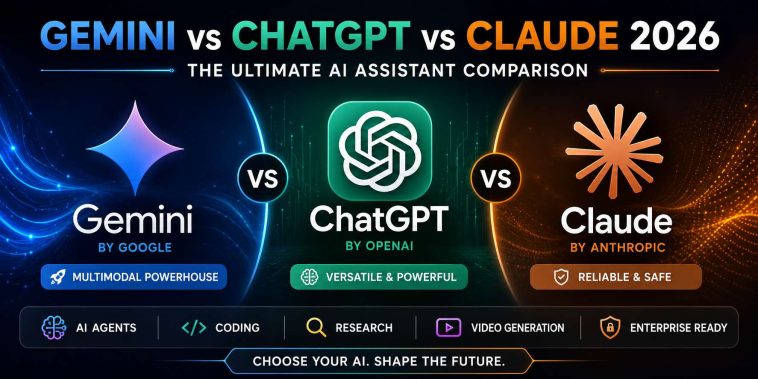
Artificial Intelligence assistants have evolved from simple chatbots into powerful digital collaborators capable of writing code, generating videos, conducting research, automating workflows, analyzing data, and even acting as autonomous agents. In 2026, the competition between Google’s Gemini, OpenAI’s ChatGPT, and Anthropic’s Claude has reached an entirely new level.
The AI race is no longer just about who has the smartest chatbot. It is now about ecosystem dominance, multimodal intelligence, AI agents, reasoning, safety, productivity integration, developer tools, and enterprise adoption.
Google I/O 2026 became one of the biggest turning points in this competition. Google unveiled Gemini Omni, Gemini 3.5 Flash, agentic AI systems, Android XR integrations, and the most significant Search transformation in 25 years.
Meanwhile, OpenAI continued pushing ChatGPT forward with GPT-5.5, advanced reasoning, memory upgrades, autonomous workflows, and broader ecosystem integrations.
Anthropic focused heavily on reliability, coding, enterprise automation, and AI safety with Claude Opus 4.7 and major improvements to Claude Code.
This detailed comparison explores every major update, feature, strength, weakness, and use case across Gemini, ChatGPT, and Claude in 2026.
The AI Landscape in 2026
The AI assistant market in 2026 revolves around five major pillars:
- Reasoning Intelligence
- Multimodal Capabilities
- AI Agents & Automation
- Coding & Development
- Ecosystem Integration
All three companies have adopted different strategies:
- Google is betting on ecosystem-wide AI integration.
- OpenAI is building a universal AI operating layer.
- Anthropic is prioritizing trustworthy and enterprise-grade AI.
The result is a fascinating three-way battle.
Gemini 2026: Google’s Agentic AI Revolution
Google I/O 2026 Changed Everything
At Google I/O 2026, Google introduced its most ambitious AI vision yet. The company shifted Gemini from a chatbot into a complete AI operating ecosystem.
Major announcements included:
- Gemini Omni
- Gemini 3.5 Flash
- Gemini Spark AI Agent
- Antigravity AI Framework
- AI-powered Google Search
- Android XR smart glasses
- Universal Cart
- Gemini integration across Workspace and Chrome
Recommendation: Google IO 2026
Google’s strategy is clear: make Gemini the AI layer across every Google product.
Gemini Omni: Google’s Biggest Leap
Gemini Omni became Google’s flagship multimodal AI model in 2026. Unlike earlier models focused mainly on text and images, Gemini Omni can generate and manipulate:
- Text
- Audio
- Images
- Video
- Documents
- Simulations
Google described it as “create anything from any input.”
This is arguably the strongest multimodal system currently available.
Key Features of Gemini Omni
- Video generation from prompts
- Conversational video editing
- Real-time multimodal understanding
- Advanced world modeling
- Cross-platform media generation
- AI avatar creation
- YouTube Shorts integration
Gemini Omni Flash especially impressed creators because it allowed users to modify videos conversationally without breaking continuity.
This gives Google a huge advantage in content creation.
Gemini 3.5 Flash
Google also launched Gemini 3.5 Flash as the default Gemini model.
The model focuses on:
- Faster responses
- Better coding
- Lower inference costs
- Agentic workflows
- Real-time actions
Unlike earlier Gemini versions, 3.5 Flash was designed specifically for autonomous task execution.
Google emphasized “frontier intelligence with action.”
That phrase perfectly summarizes Google’s direction.
Gemini Spark and AI Agents
One of the biggest trends of 2026 is AI agents.
Google introduced Gemini Spark, an always-on AI assistant capable of:
- Booking tasks
- Managing workflows
- Searching documents
- Completing multi-step operations
- Interacting with apps autonomously
Google also expanded Antigravity into a full AI agent development platform.
This positioned Google directly against OpenAI’s agent systems and Anthropic’s Claude Code ecosystem.
Gemini and Search
Google Search received its biggest overhaul in 25 years.
AI-generated interfaces became deeply integrated into search experiences.
Major updates included:
- Personalized AI search summaries
- Interactive search conversations
- AI-generated mini apps
- Context-aware recommendations
- Dynamic shopping experiences
This dramatically changes how users interact with the web.
However, it also raised concerns among publishers and SEO professionals.
Gemini’s Biggest Strengths
1. Ecosystem Integration
No AI platform integrates better with:
- Gmail
- Docs
- Chrome
- Android
- YouTube
- Maps
- Workspace
Google’s ecosystem advantage is massive.
2. Multimodal Leadership
Gemini Omni currently leads in:
- Video AI
- Image understanding
- Cross-modal reasoning
3. Search Dominance
Google can inject Gemini directly into billions of daily searches.
4. Android XR & Wearables
Google’s Android XR smart glasses and AI wearables could become the future of ambient AI computing.
Gemini’s Weaknesses
Despite rapid improvements, Gemini still struggles in some areas:
- Occasional factual inconsistency
- Less polished conversational personality
- Complex subscription structure
- Weaker long-form writing compared to Claude
Google is improving rapidly, but consistency remains a challenge.
ChatGPT 2026: OpenAI’s Universal AI Platform
GPT-5.5 and the Evolution of ChatGPT
OpenAI launched GPT-5.5 in 2026 as its most capable model yet.
The company described it as:
“A new class of intelligence for real work.”
GPT-5.5 focuses heavily on:
- Reasoning
- Memory
- Agentic workflows
- Coding
- Productivity
- Reliability
ChatGPT is no longer just a chatbot. It is becoming a full AI operating environment.
GPT-5.5 Instant
OpenAI also released GPT-5.5 Instant as the new default ChatGPT model.
Key improvements included:
- Lower hallucinations
- Faster responses
- Better memory
- Shorter, cleaner answers
- Stronger factual accuracy
GPT-5.5 Instant especially improved high-stakes domains like:
- Law
- Finance
- Medicine
ChatGPT’s AI Agent Capabilities
OpenAI invested aggressively in autonomous AI agents.
Modern ChatGPT can now:
- Browse the web
- Operate software
- Generate spreadsheets
- Conduct research
- Write code
- Manage workflows
- Execute multi-step tasks
GPT-5.5 was specifically designed to “get work done on a computer.”
This puts OpenAI ahead in general-purpose productivity.
ChatGPT Memory and Personalization
One major differentiator is ChatGPT’s evolving memory system.
The platform now remembers:
- User preferences
- Writing styles
- Past conversations
- Ongoing projects
- Productivity habits
This creates a much more personalized AI experience.
OpenAI has arguably built the most “human-feeling” assistant in 2026.
Coding and Development
ChatGPT remains incredibly strong for developers.
Major advantages include:
- Full-stack coding support
- Debugging
- API integrations
- Documentation generation
- Workflow automation
- Interactive coding assistance
GPT-5.5 also integrates deeply into coding environments.
The emergence of Codex-style autonomous coding agents further strengthened OpenAI’s developer ecosystem.
ChatGPT’s Biggest Strengths
1. Best Conversational Experience
ChatGPT still feels the most natural for:
- Brainstorming
- Writing
- Collaboration
- General conversation
2. Excellent Reasoning
GPT-5.5 excels at:
- Logic
- Planning
- Analysis
- Research synthesis
3. Strongest General Productivity Tool
For most users, ChatGPT offers the best balance of:
- Writing
- Research
- Coding
- Automation
- Creativity
4. Huge Plugin & Tool Ecosystem
OpenAI’s integrations remain unmatched.
ChatGPT’s Weaknesses
1. Expensive Advanced Tiers
Premium capabilities can become costly.
2. Hallucinations Still Exist
Although improved, GPT-5.5 is not perfect.
3. Video AI Still Behind Gemini
Google currently leads in native multimodal video generation.
Claude 2026: The Reliability and Coding King
Anthropic’s Strategy
Unlike Google and OpenAI, Anthropic focused heavily on:
- AI safety
- Enterprise trust
- Long-context reasoning
- Coding excellence
- Reliability
This approach made Claude extremely popular among developers and enterprises.
Recommendation : Do you know why Claude AI is most powerful AI Tool ?
Claude Opus 4.7
Anthropic introduced Claude Opus 4.7 in 2026 with major upgrades in:
- Multi-step workflows
- Tool usage
- Coding
- Reliability
- Context handling
Anthropic claimed Opus 4.7 achieved:
- 14% better performance than Opus 4.6
- Fewer tool errors
- Lower token usage
Claude Code and the AI Coding Boom
Claude Code became one of the most influential AI coding systems in 2026.
According to reports, developers became obsessed with Claude-powered autonomous coding workflows.
Claude’s coding advantages include:
- Long-context understanding
- Better repository comprehension
- Structured outputs
- Reliable tool use
- Reduced hallucinations in programming tasks
Many developers now prefer Claude for large software projects.
Claude’s Massive Context Window
Claude remains the king of long-context processing.
This matters enormously for:
- Legal analysis
- Research papers
- Massive codebases
- Documentation
- Enterprise workflows
Claude handles huge inputs better than most competitors.
Claude and AI Safety
Anthropic continues emphasizing AI safety and interpretability.
This has become increasingly important as AI agents gain autonomy.
Claude often behaves more cautiously and transparently than rivals.
That makes it especially attractive to enterprises and regulated industries.
Claude’s Biggest Strengths
1. Best for Long Documents
Claude dominates in:
- Long-form reading
- Summarization
- Research analysis
2. Elite Coding Performance
Claude Code became a favorite among advanced developers.
3. Reliable and Structured Outputs
Claude often produces cleaner and more consistent responses.
4. Enterprise Trust
Anthropic’s safety-first positioning appeals strongly to businesses.
Claude’s Weaknesses
1. Smaller Ecosystem
Claude lacks the massive consumer ecosystem of Google and OpenAI.
2. Less Multimodal Power
Claude trails Gemini in video and media generation.
3. Less Consumer-Oriented
Claude feels more professional than personal.
Gemini vs ChatGPT vs Claude: Head-to-Head Comparison
| Feature | Gemini | ChatGPT | Claude |
|---|---|---|---|
| Best Overall Ecosystem | Excellent | Very Strong | Moderate |
| Conversational Quality | Strong | Excellent | Very Good |
| Coding | Excellent | Excellent | Elite |
| Video Generation | Best | Good | Limited |
| Research | Strong | Excellent | Excellent |
| Long Context | Very Good | Strong | Best |
| AI Agents | Excellent | Excellent | Very Good |
| Enterprise Trust | Strong | Strong | Excellent |
| Search Integration | Best | Moderate | Limited |
| Productivity | Excellent | Excellent | Strong |
| Creativity | Excellent | Excellent | Moderate |
| Safety Focus | Strong | Strong | Best |
Which AI Assistant Is Best in 2026?
Choose Gemini If You Want:
- The best multimodal AI
- Advanced video generation
- Deep Google integration
- AI-powered search
- Android ecosystem support
Gemini is ideal for creators, Android users, and multimedia workflows.
Choose ChatGPT If You Want:
- The best all-around assistant
- Strong reasoning
- Great writing
- Powerful productivity
- Versatile AI agents
ChatGPT remains the best universal AI assistant for most users.
Choose Claude If You Want:
- Elite coding support
- Massive context windows
- Reliable enterprise AI
- Long-document analysis
- Safe and structured outputs
Claude is especially strong for developers, researchers, and enterprises.
The Future of AI Assistants
The next phase of AI competition will focus on:
- Autonomous agents
- Persistent memory
- Wearable AI
- Real-time multimodal intelligence
- Personalized AI ecosystems
Google is betting on ambient AI integrated into daily life.
OpenAI is building the universal AI operating system.
Anthropic is building trustworthy AI infrastructure.
All three companies are shaping the future of human-computer interaction.
Final Verdict
In 2026, there is no single winner.
Each AI assistant dominates different categories:
- Gemini leads in multimodal AI and ecosystem integration.
- ChatGPT remains the best all-purpose assistant.
- Claude dominates coding reliability and long-context intelligence.
The most important takeaway is this:
AI assistants are no longer tools. They are becoming digital collaborators capable of performing real-world work autonomously.
And after Google I/O 2026, the AI race has officially entered its most competitive era yet.